1
Submit Your Request
Provide your contact information, delivery address, unloading location, and truck access details.
Looking for arborist mulch for your property? Canopy Solutions LLC offers fresh, locally generated arborist mulch from professional tree-care operations throughout the greater Seattle area.
Our arborist mulch consists of mixed, unscreened wood chips that may contain wood, bark, leaves, evergreen needles, and small twigs.
Unlike commercially processed decorative mulch, our material is generated directly from professional pruning and tree removal. Its appearance, species composition, and texture vary by load.
Submit a delivery request to be considered when crews are working nearby. Any applicable delivery charges will be discussed before scheduling.
Request Arborist MulchDelivery is subject to availability. Requests do not guarantee delivery or establish a scheduled appointment.
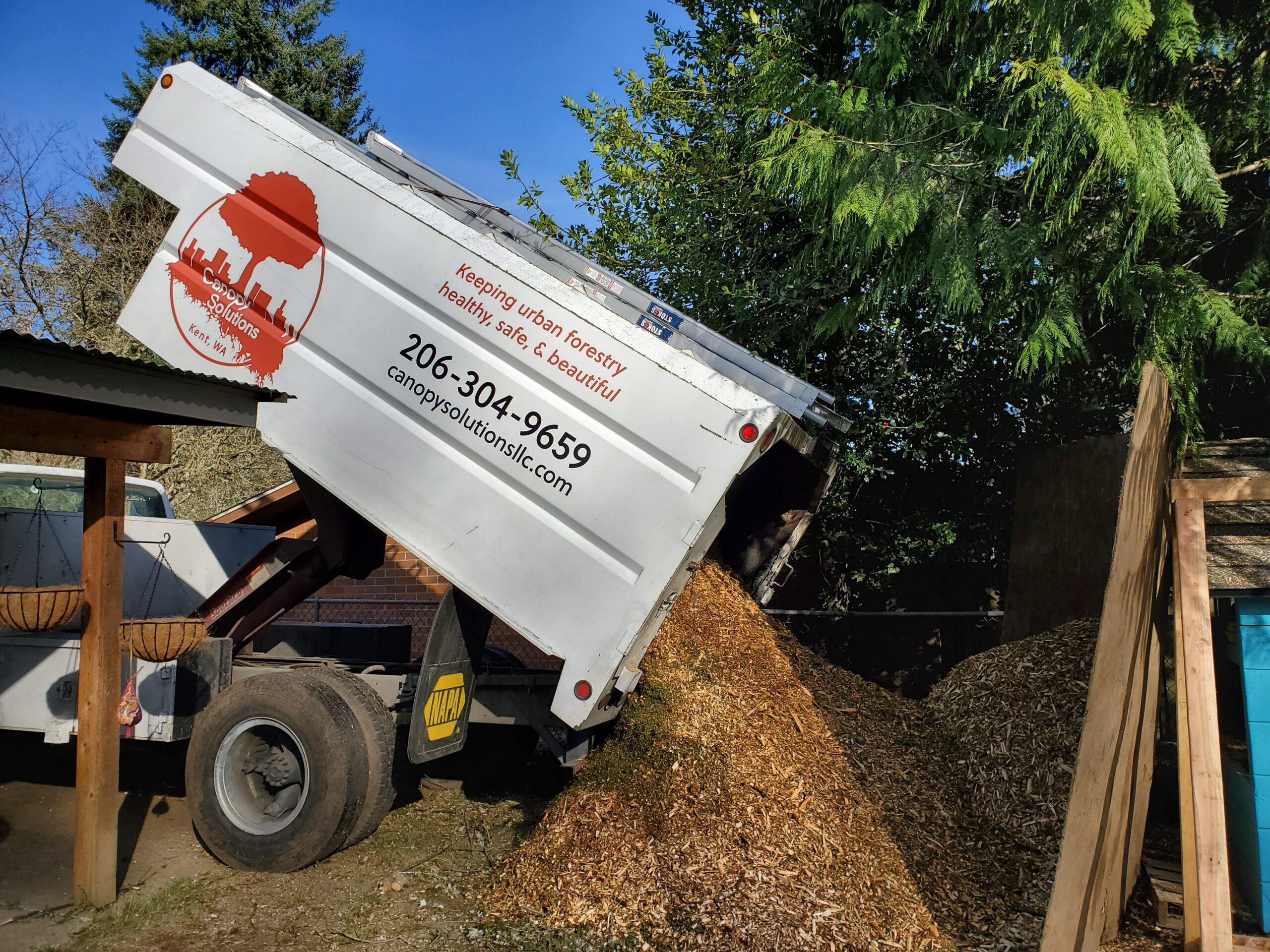
Our arborist mulch program connects locally generated material with properties that can put it to use. Deliveries are considered alongside our regular tree-care schedule.
Provide your contact information, delivery address, unloading location, and truck access details.
When crews generate suitable mulch nearby, we review requests in the surrounding area.
If an opportunity is available, we confirm the location, delivery conditions, and any applicable charges before scheduling.
Research discussed by Washington State University horticulturist Dr. Linda Chalker-Scott identifies several advantages of arborist wood chips in landscapes with trees and shrubs.
A surface layer of wood chips can reduce evaporation and help retain water in the soil.
Mulch helps insulate soil from temperature extremes and rapid fluctuations.
An appropriate mulch layer can reduce the light available for weed germination and growth.
As wood chips decompose, they contribute organic matter to the soil surface.
Mixed woody material provides habitat for decomposers and other soil organisms.
Arborist mulch reuses woody material generated during local tree-care operations.
Arborist mulch is fresh, mixed tree material rather than screened, uniform, commercially processed bark.
Our chip truck is a large, heavy commercial vehicle. Safe unloading requires room to position the truck and raise the dump body.
Check for power lines, communication lines, branches, roof overhangs, and structures.
The unloading surface must be suitable for a loaded commercial truck. Lawns, soft ground, and some paved surfaces may not be suitable.
Disclose known septic systems, drain fields, buried utilities, irrigation, vaults, and other underground improvements.
Adequate space is needed to enter, unload, and leave without damaging fences, walls, vehicles, landscaping, or adjacent property.
Our driver has final discretion over safe access and unloading. Delivery may be declined if conditions are unsuitable.
Research summarized by Dr. Chalker-Scott distinguishes nitrogen changes at the mulch-soil interface from nitrogen availability deeper in the root zone.
When wood chips are applied on the soil surface rather than mixed into it, they generally do not cause the widespread nitrogen deficiency sometimes associated with woody materials.
Arborist mulch is generally best suited to landscape trees, shrubs, and ornamental beds. Vegetable and annual planting beds may have different management needs.
The research article explains that decomposing mulch may undergo temporary chemical changes, but these do not necessarily produce meaningful changes in the pH of underlying landscape soils.
The research review explains that many fungi associated with wood-chip mulch are decomposers rather than plant pathogens.
It also discusses why wood-chip mulch does not automatically create the pest or disease problems commonly attributed to it.
However, material sources and landscape conditions vary. Mulch should not be placed against trunks or used as planting-hole backfill.
For general landscape maintenance, begin with approximately 2–4 inches of mulch over a broad area, adjusting for site conditions, material texture, and weed-management objectives.
Spread mulch over as much of the root zone as practical, while keeping the trunk and root flare uncovered.
Do not pile wood chips against the trunk or cover the root flare.
The research article emphasizes tapering mulch down as it approaches the trunk to avoid excessive moisture against the bark.
The linked research article also discusses deeper applications for certain ornamental and restoration weed-control objectives. Mulch depth should be selected for the site rather than treated as one universal requirement.
No specific date, species, composition, or load quantity can be guaranteed. Opportunities depend on scheduled tree-care work and material availability.
Any applicable delivery charges will be communicated before a delivery is scheduled. Submitting a request does not authorize a charge or require you to accept a delivery.
For property owners interested in learning more, we recommend the article Wood Chip Mulch: Landscape Boon or Bane? by Linda Chalker-Scott, Ph.D., a Washington State University Extension horticulturist.
The article discusses the landscape benefits of wood chips, addresses common misconceptions about nitrogen, soil acidity, pests, and disease, and provides recommendations for application.
Source: Linda Chalker-Scott, Ph.D., "Wood Chip Mulch: Landscape Boon or Bane?", MasterGardener, Summer 2007. Research is provided for educational purposes.Arborist mulch is one useful part of responsible landscape management. Learn more about our professional tree pruning services and plant health care services for support with tree health, maintenance, and growing conditions.